 Reserve your hunt
Read the clue
Filippo gives you a clue. It's not a ready-made answer: you have to read it, understand it, and follow it.

The Demo
Filippo gives you a clue.
You need to figure out where it's taking you.
On the Hunt with Filippo is a narrative, geolocated scavenger hunt to be experienced in Venice using your smartphone.
The demo helps you get the hang of the game: you receive a clue, search for a location, check the answer, read the stage description, and move on.
The only difference is practical: you don't walk through the narrow streets, squares, and bridges. You simulate the journey remotely, but the sequence is the same.
This isn't a technical test of the web app. It's the first step in the scavenger hunt: it helps you figure out, through play, how Filippo will ask you to read the clue, find the location, and take a closer look at what's in front of you.
On Kickstarter, at a discounted backer price. You only pay if the campaign reaches its goal.

The Story
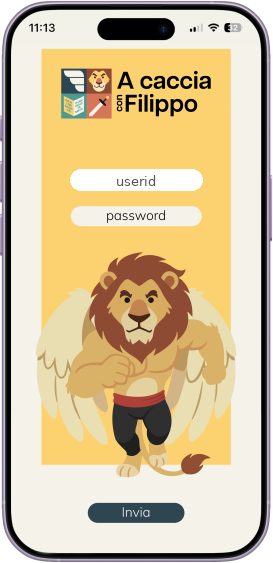
Philip is the lion who accompanies the hunt. In the story, three elements were taken from him: his wings, his sword, and his book. These are three symbols that connected him to the city.
To recover them, he can't do it all on his own. He asks you to follow a trail, stop at certain places, and take a closer look at what's in front of you.
Filippo is a fictional character and should be treated as such: a narrative guide, not a historical source.
The places, however, are real. The Venetian words are those of the city itself. The stories and legends are recounted with care, distinguishing between what is documented and what is part of the narrative.
This is where the demo begins: it doesn’t promise you a fictional or more spectacular Venice. It asks you to observe what’s already right in front of you, but often goes unnoticed.
Every detail can be a clue. But you have to figure it out for yourself.
Try the Hunting Puzzle
The demo works just like an actual gameplay sequence: read, search, enter, verify, read the stage description, and solve the puzzle to continue.
You don't have to know everything already. You have to read the clue, figure out where to look, identify the right place, and enter the correct answer.
If you pick the wrong place, Filippo won't let you continue. He'll send you back to the clue: reread it, look more carefully, and correct your course.

The Steps in the Demo
In the demo, you don't walk between stages, but the gameplay follows the same steps as a real hunt.
Filippo gives you a clue. It's not a ready-made answer: you have to read it, understand it, and follow it.
The point isn't to already know everything; it's to understand where to look and what to observe.
When you think you know where to go, type in the name requested by the demo.
If the location is incorrect, Filippo won't let you continue. Reread the clue and look more carefully.
The place becomes a story: history, legend, a detail, or a Venetian word.
Each answer unlocks the next step. The city, even from a distance, remains the center.
The Logic Behind the Demo
The demo follows the same logic as a real-life hunt. The approach is different: instead of walking through the narrow streets and across the bridges, you simulate the movement remotely.
But the method is the same: observe, make connections, try things out, correct yourself, and arrive at the right place.
Maps are a tool. The answer, however, always arises from the relationship between a clue, a place, and a perspective.
Demo and Real Hunting
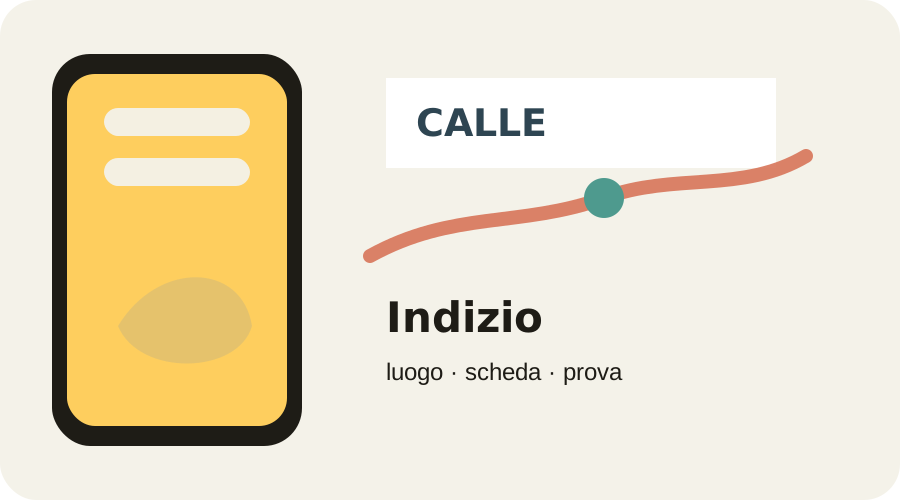
In a real-life hunt, you have to physically get to the right spot. In the demo, you have to find it remotely. In both cases, though, it’s not enough to just guess—you have to figure out where the clue is leading you.
You can find the location remotely using maps.
You walk through narrow streets, squares, and over bridges.
Clue, research, verification, worksheet, test.
If you like the way you think here, you'll like it even more while you're walking.
Before You Begin
This is a remote simulation: since you can't physically move around Venice, you'll use Google Maps or Apple Maps to figure out where the clue is leading you.
When you think you've found the place, type its name into the game.
The name should be written as one word, without spaces, with only the first letter capitalized.
For example: if your destination is the Rialto Bridge, type Pontedirialto.
The same rule applies to the password: words joined together, without spaces, with only the first letter capitalized.
For example: if the password were "Rialto Bridge + Doge," type Pontedirialtodoge.
If a number appears, write it in digits, not in words.
You can use search engines, Google Maps, and Apple Maps. It’s not cheating: even in real-life treasure hunts, the point isn’t to already know everything, but to figure out where to look, what to observe, and what answer to enter to move forward.
The rule is simple: destinations and passwords without spaces, with only the first letter capitalized. The correct answer, however, is almost never just a single word to guess—it’s the result of a closer look.
Why Try It?
The demo is meant to help you get a feel for the project's pace: it's not a guided tour, not a quiz, and not a collection of trivia to be consumed.
It’s the first step in the hunt: it shows you how Filippo speaks, how the clues work, why place names matter, and why your smartphone should remain a tool—not the star of the show.
It's best to find out here before choosing a real hunt.
Enter your name and email address to start the demo right away.